

The University Hospital RWTH Aachen
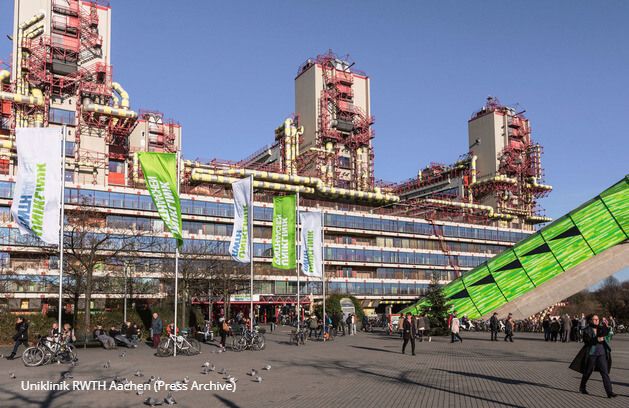
University Hospital Aachen is a maximum-care medical facility providing patients with the highest standards of medical services. Its organizational structure represents a unique integration of clinical, educational, and research centers, all housed in a state-of-the-art facility. The close interaction between practical and scientific medicine fosters intensive collaboration among physicians across specialties.
With the establishment of the Faculty of Medicine on June 18, 1966, the state hospital in Aachen was granted university hospital status. Rapidly increasing patient numbers led to the decision to construct a new building, with construction beginning in 1971. The project lasted over a decade, and phased commissioning of the new facilities began in 1982. The hospital was fully operational on March 21, 1985.
Over the past 37 years, the multidisciplinary university hospital in Aachen has gained international recognition. Given the complexity of the medical cases treated, it ranks as the leading facility in the region.
Key Areas of Expertise
University Hospital Aachen provides comprehensive care across all fields of modern medicine. Independent rankings by Newsweek highlight the following departments and centers:
- Center for Integrated Oncology (CIO)
- Department of Orthopedics and Certified Endoprosthetics Center
- Certified Breast Cancer Center
- Department of Neurosurgery
- Department of Neurology
- Department of Gastroenterology
- Department of Cardiology, Angiology, and Intensive Care
- Department of Cardiac Surgery
- Department of Urology
- Department of Ophthalmology
- Department of Otorhinolaryngology
- Department of Radiation Therapy
Center for Integrated Oncology
Since 2018, the Aachen Oncology Center, in collaboration with university hospitals in Bonn, Cologne, and Düsseldorf, has formed the Center for Integrated Oncology (CIO Aachen, Bonn, Cologne, Düsseldorf).
All participating departments and institutes of the university hospital involved in cancer diagnosis, treatment, and research are integrated into the CIO to ensure maximum-care services for oncology patients.
The multidisciplinary collaboration among CIO experts enables the effective application of clinical experience in cancer treatment. The center coordinates patient diagnostics, therapy, post-treatment follow-up, and ongoing physician training.
Joint research by the CIO team has uncovered molecular mechanisms underlying tumor development. This knowledge has enabled the implementation of individualized treatment plans based on the tumor’s genetic profile (personalized therapy).
Department of Urology
The Department of Urology employs 16 physicians and over 30 supporting staff. The department provides both surgical and medical treatment for all types of urological cancers, including:
- Prostate carcinoma
- Renal cell carcinoma
- Bladder cancer
- Testicular cancer
- Penile cancer
Treatment of urolithiasis (kidney, ureter, and bladder stones) is performed using modern minimally invasive techniques. With the establishment of a robotic surgery unit and fusion-guided prostate biopsy, University Hospital Aachen has entered the era of digital surgery.
Pediatric urology services are provided in collaboration with the Department of Pediatrics.
Treatment of reproductive disorders involves coordination with the Department of Gynecology and Reproductive Medicine. Surgical and conservative therapy for urinary incontinence in men and women is offered through the specialized Incontinence Center.
Department of Orthopedics
The Department of Orthopedics at University Hospital Aachen has a long-standing tradition, founded by Professor Friedrich Pauwels. Today, the certified Orthopedics Center is led by distinguished orthopedic surgeon Professor Markus Tingart.
Professor Tingart’s team focuses on advancing existing orthopedic methods and developing innovative surgical techniques. The department treats approximately 15,000 patients annually and performs over 1,500 surgeries per year, covering the full spectrum of conservative and surgical orthopedic care.
Department of Cardiac Surgery
The department provides comprehensive cardiac surgery for children and adults with congenital heart defects, including procedures on the ascending aorta and aortic arch, tracheal surgery, and minimally invasive techniques.
The department is headed by Professor André Rüffer, repeatedly recognized in independent FOCUS magazine rankings as one of Germany’s top pediatric cardiac surgeons.
Department of Neurosurgery
The Department of Neurosurgery offers the full spectrum of modern neurosurgical care, including:
- Skull base and pituitary tumor surgery using neuronavigation and intraoperative neuromonitoring
- Brain tumor resection using fluorescent neuronavigation
- Awake brain surgery
- Spine surgery for disc herniation and spinal canal stenosis
- Resection of spinal cord tumors
- Treatment of cerebrovascular diseases
- Specialized pediatric neurosurgery
- Trigeminal neuralgia treatment
- Deep brain stimulation for Parkinson’s disease
- Epilepsy surgery
- Neurotraumatology
The department’s modern treatment strategies emphasize interdisciplinary collaboration and active participation in scientific research.
The department is led by Professor Hans Clusmann, Vice President of the German Society of Neurosurgeons, and recipient of numerous prestigious awards for research in neurosurgery.