

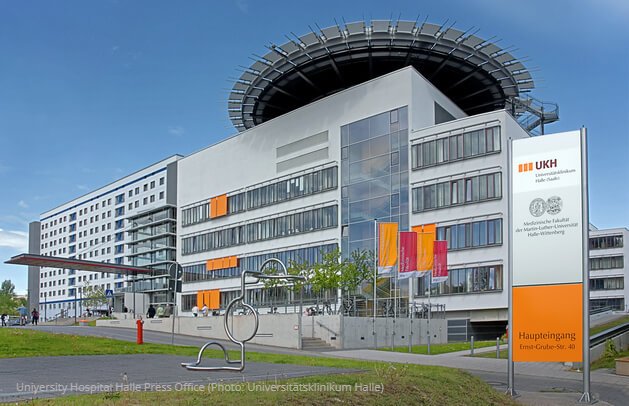
The University Hospital Halle (Saale)
Halle (Saale) University Hospital is a nationally recognized medical center providing tertiary (maximum-level) care for complex, severe, and rare diseases and injuries. Patients are treated in accordance with the latest advancements in medicine, supported by close collaboration with the Faculty of Medicine at Martin Luther University Halle-Wittenberg. The hospital’s key areas of specialization include cardiovascular diseases and oncology.
Physicians at Halle University Hospital utilize advanced technologies in diagnostics and treatment, including a state-of-the-art hybrid operating room in the cardiology center and the da Vinci surgical system in urology.
The Transplantation Center, with more than 40 years of experience, performs over 40 kidney transplants annually, with a particular focus on living donor transplantation. At the Perinatal Center, highly complex procedures are carried out to save the lives of unborn children through advanced fetal interventions.
Key Figures and Facts
With approximately 4,450 employees, Halle University Hospital is one of the largest employers in the federal state of Saxony-Anhalt. The hospital comprises 30 departments and centers, treating more than 240,000 patients annually.
According to the Newsweek 2025 ranking, Halle University Hospital is among the top university hospitals in Germany, achieving a score of 74.17. The ranking is based on surveys of over 85,000 medical experts, patient satisfaction data, and hygiene standards.
Department of Cardiac Surgery
Modern technologies enable the successful treatment of various heart valve diseases, even in high-risk patients, using minimally invasive techniques, including:
- Minimally invasive heart valve surgery (aortic and mitral valve procedures)
- Catheter-based aortic valve interventions (transfemoral and transapical implantation)
- Minimally invasive coronary artery surgery
For many years, minimally invasive approaches to heart valve surgery have been the standard at the center. In most cases, valve replacement or reconstruction can be performed without full sternotomy (complete division of the breastbone), instead using a small intercostal incision or partial sternotomy.
In close collaboration with cardiology specialists, the center’s experts provide patients with the full spectrum of individualized treatment options for cardiovascular diseases, ensuring optimal outcomes based on each patient’s specific condition.